
July 7, 2026
Gun Talk Staff
Every year the SHOT Show — the world’s largest trade show for the firearms, ammunition, and outdoor sports industry — functions as a bellwether for where the market is headed. The 2026 edition, held January 20-23 at the Venetian Expo and Caesars Forum in Las Vegas, drew more than 53,000 industry attendees from 2,744 exhibitors across 126 countries, filling more than 77,000 square meters of show floor, a scale All4Shooters’ full show coverage documented in detail. What those exhibitors showed, and what the buyers responded to, tells a clear story about the direction of the American firearms market in 2026.
It is a story defined by three dominant trends that have been building for years and reached maturity simultaneously: the mainstreaming of suppressors driven by the NFA tax repeal, the universal adoption of optics-ready design across pistol price points, and the emergence of true modularity as the consumer expectation rather than the premium upgrade. Each of these trends reshapes what gun owners buy, how they configure their firearms, and what manufacturers must deliver to remain competitive. Together, they represent the most significant structural shift in the consumer firearms market in at least a decade, one that Outdoor Life’s SHOT Show podcast coverage and NSSF’s own attendance and industry data both help put in context.
No single policy change has restructured the firearms accessories market more dramatically than the elimination of the $200 NFA tax stamp on suppressors, which took effect January 1, 2026. The market’s response was immediate and staggering. On the first day of 2026, ATF processed more than 150,000 eForm submissions — roughly 60 times the daily average. What followed was a product development land rush that was on full display at SHOT Show 2026.
Industry observers noted at SHOT that virtually every manufacturer now offers at least one suppressor model, with new entrants ranging from established firearms companies entering the suppressor space for the first time to startups launching suppressor-first business models. One industry writer observed that a “full-on race to the bottom” was underway on pricing, with the elimination of the $200 tax compressing the effective cost difference between manufacturers and pushing companies to compete aggressively on price. Banish expanded its shotgun suppressor lineup to include 20-gauge and .410 versions alongside its existing 12-gauge model. Bergara, Canik, Diamondback, Hi-Point, Palmetto State Armory, and Lyman Products all launched their first suppressors at or around SHOT Show 2026.
The secondary effect of suppressor mainstreaming is equally significant: threaded barrels have become standard across virtually every rifle and growing numbers of pistols, “suppressor-ready” has replaced “threaded barrel available” as the expected specification, and integral suppressor designs — where the suppressor is built directly into the barrel system — emerged as a major 2026 product category. The FM Products Ranch Rifle ISU-556 G2 with its integral suppressor and monolithic billet upper exemplifies this direction. The Savage 110 platform’s AC30 BOB (Back-over-Barrel) suppressor design, which we covered earlier this year, is another expression of the same trend: manufacturers designing the suppressor into the rifle, not bolting it on as an afterthought.
“Every manufacturer is offering silencers now. There’s a full-on race to the bottom to see how cheaply they can be sold.” — Industry observer at SHOT Show 2026
For gun owners, the practical message is straightforward: the cost barrier to suppressed shooting has effectively been cut in half by the tax elimination, and the product selection has never been broader or more competitive. If you have been waiting to enter the suppressor market, 2026 is the year the market came to meet you.
Walk any gun store in America in 2026 and try to find a new defensive or duty pistol without an optics cut on the slide. It is getting harder. What was a premium feature three years ago — a slide machined to accept a red dot sight — has become the expected baseline specification across virtually every pistol price point.
The data from SHOT Show 2026 is unambiguous on this point. NRA Women’s coverage of the show noted explicitly that “optics-ready is becoming standard for pistols at all price points.” The Taurus TX9 series, positioned as an affordable option, launched optics-ready across its subcompact, compact, and full-size models. The Glock Gen 6, which we covered in depth this month, redesigned its entire optics mounting system as the centerpiece upgrade. The Steyr Arms AT series launched with optics-ready specification at its core. Kimber’s 2K11 Comp launched with an integrated compensator and optics compatibility built in simultaneously. The Ruger 10/22 Standard model updates included optics-ready packages at the $299 price point.
The shift has been driven by two converging forces. First, the suppressor mainstreaming trend: a shooter running a suppressed pistol is almost always running a red dot, because iron sights at standard height do not co-witness correctly with a suppressor-height sight picture. The suppressor boom created demand for optics-ready slides at every price point. Second, a decade of competitive pressure from the defensive shooting training community, which has evangelized the practical advantages of pistol-mounted red dots — faster target acquisition, better low-light performance, improved accuracy for aging eyes — has brought optics from the competition circuit to the everyday carry holster.
The integral compensator trend is closely related. Kimber’s 2K11 Comp, the Smith & Wesson M&P M2.0 Carry Comp in 10mm, and multiple other 2026 launches combined optics cuts with built-in compensators — recognizing that the shooter who wants a red dot is also the shooter who benefits from reduced muzzle flip during rapid fire. These features are no longer selling points. They are table stakes.
The third defining trend of 2026 is arguably the most structural: modularity has shifted from a premium differentiator to the consumer baseline expectation. Gun owners in 2026 expect to be able to customize their firearms — stocks, triggers, grips, barrels — from a wide range of common-pattern aftermarket parts, without paying a custom shop premium or voiding a warranty.
NRA American Rifleman’s full 2026 new guns guide specifically called out modularity as one of the three defining trends of the market year, noting that “all types of firearms are becoming ‘modular,’ meaning that the owner can customize everything from stocks to triggers to grips to barrels on their own, choosing from a wide range of common-pattern aftermarket parts.” The Savage Impulse Core Hunter Pro exemplifies this — interchangeable grip modules in small, medium, and large, an AccuFit V2 stock with tool-free comb height and length-of-pull adjustment, and M-Lok attachment points throughout. The Bergara Platinum Stalker answered customer demand for a hunting rifle with a laminated wood stock — itself a modularity-adjacent choice that prioritizes dimensional stability and customizability over aesthetics. The revived Glenfield Model A — a rebadged Ruger American at a lower price point — enters a market where buyers understand they can upgrade triggers, stocks, and optic systems independently.
The modularity trend connects directly to the suppressor and optics-ready trends in a meaningful way: a modular firearm is a suppressor-ready, optics-configurable platform that the owner can adapt to changing use cases, regulations, and preferences without buying a new gun. The shooter who buys a modular rifle in 2026 is buying a platform, not a fixed tool — and manufacturers who understand this are designing around the platform concept from the ground up.
The Glenfield revival is worth specific attention as an expression of the value-modularity intersection. Ruger revived the Glenfield name specifically to reach the price-sensitive buyer who wants the American’s action, trigger, and reliability at a lower entry cost — with the understanding that they can add stocks, triggers, and optics incrementally. This is the modular market logic applied to the entry-level buyer: sell the platform, let the ecosystem provide the rest.
The convergence of these three trends creates the most favorable buyer’s market in American firearms history. Suppressor pricing has been compressed by competition. Optics-ready specification is standard at every price point. Modular platforms give buyers the ability to upgrade incrementally. The question is no longer “could I get a suppressor-ready, optics-compatible, modular rifle” — it is “which one and at what price point.”
| Suppressors | Tax eliminated. Competition driving prices down. Threaded barrels now standard. Integral suppressor designs emerging as product category. Buy now — it’s never been cheaper or easier. |
|---|---|
| Optics-ready pistols | Now standard at every price point. If your new pistol doesn’t have an optics cut, you’re buying 2022’s specification. Enclosed emitters growing fast. Glock Gen 6 ORS sets new standard. |
| Modular rifles | Fully adjustable stocks (tool-free), interchangeable grips, M-Lok everywhere. Entry-level buyers now access modular platforms (Glenfield Model A) that were premium features 5 years ago. |
| Value proposition | NRA American Rifleman called 2026 “a buyer’s market.” Competition is driving features down-market. You get more gun for the money than at any previous point in modern firearms history. |
| Integral compensators | Moving from competition guns to everyday carry pistols. Kimber 2K11 Comp, S&W M&P Carry Comp 10mm. Expect to see these as standard options across more manufacturer lines by 2027. |
| Suppressor-host rifles | Manufacturers now designing rifles around suppressor integration from day one. Savage AC30 BOB, FM Ranch Rifle ISU-556 G2 integral suppressor, Henry SPD PREDATOR threaded barrel — this is the new design expectation. |
| Price competition | The race to the bottom on suppressors benefits buyers. The universalization of optics-ready and modular features at every price point benefits buyers. It’s genuinely a better time to buy firearms and accessories than ever before. |
Federal’s Peak Alloy case technology — which delivered a 250-300 fps velocity gain in the 6.5 Creedmoor when it launches in August — represents a fourth industry-level trend that is just beginning to play out. The U.S. Army’s licensing agreement for Peak Alloy technology signals that this is not a single-product launch. It is a platform. When .308 Winchester and additional cartridges receive the +Peak treatment, the implications for the hunting and precision shooting market will be enormous.
The NFA tax repeal covered not just suppressors but short-barreled rifles (SBRs) and short-barreled shotguns (SBSs). SHOT Show 2026 saw an unprecedented number of new SBR configurations, and that market is still expanding. Compact, suppressor-ready SBR platforms — particularly in 300 Blackout, 6mm ARC, and the growing PCC category — are positioned for significant growth in the back half of 2026 as inventory catches up with demand.
The integration of artificial intelligence into ballistic solvers — already visible in the Vortex Relay ecosystem and the Leupold BX-6 Range HD’s Hornady 4DOF calculator — is accelerating. Expect more optics, rangefinders, and ballistic apps to leverage AI-driven predictive models by year’s end, further closing the gap between factory ammunition and handload-level performance data for the average shooter.
The three trends that defined the 2026 firearms market — suppressor mainstreaming, optics-ready universalization, and modular design as baseline — share a common beneficiary: the gun owner. Regulatory change drove the suppressor market open. Competitive pressure drove optics cuts down-market. Consumer demand drove modularity from premium to standard. The result is a market that offers more capability per dollar than at any point in the history of commercial firearms, a point echoed across this year’s major buyer’s guides, including American Hunter’s roundup of the year’s best new hunting rifles and Firearms News’ June 2026 industry issue.
If you have been on the fence about building a suppressed rifle, adding an optic to your carry pistol, or upgrading to a modular precision platform — 2026 is the year the industry met you where you are. The gear has gotten better. The price has come down. The access has expanded. What you do with it is up to you.


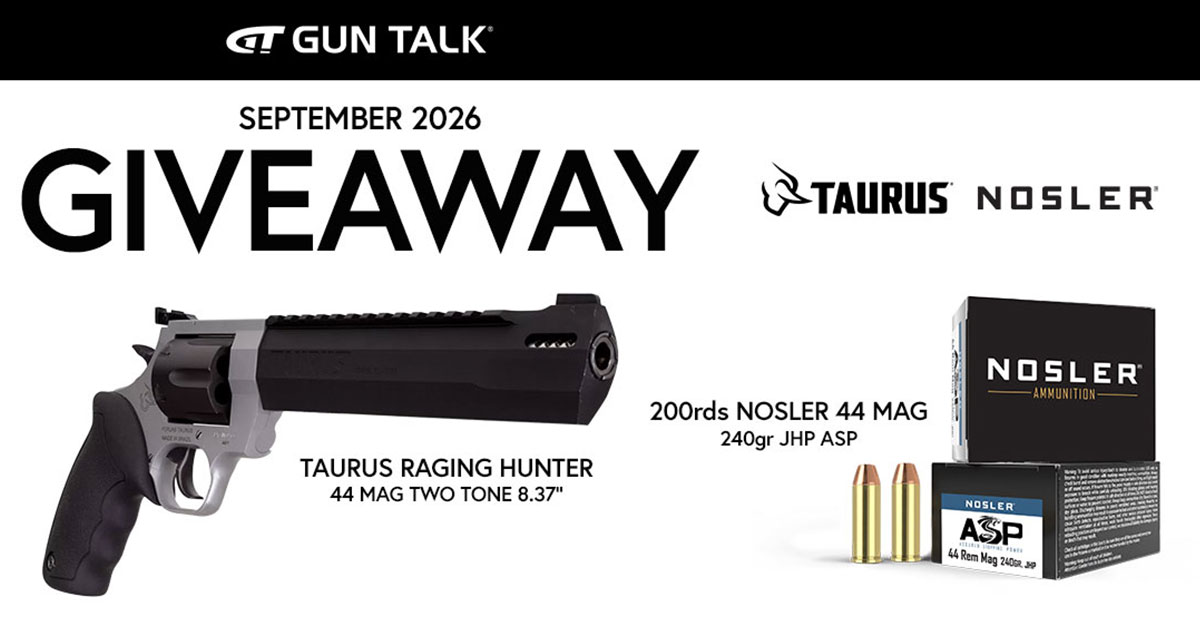
Gun Talk Giveaway
One lucky winner will bring home:
Open to U.S. residents 21+ only. Void where prohibited.