December 7, 2017
This installation is an excerpt from the book, Weatherby: The Man. The Gun. The Legend. Written by: Grits Gresham and Tom Gresham. Feel free to pick up a copy at Shop Gun Talk.
By 1957, long before there was any knowledge in the industry of the new Mark V action, the increasing popularity of the Weatherby Magnum cartridges was making the other arms companies sit up and take notice. As an example, Winchester had come out with some new magnum cartridges of their own: the .458 Winchester, the .338 Winchester and the hot little .264 Winchester. Jack O’Connor, in the March 1958 issue of Outdoor Life, referred to Winchester’s new .338 and .264 calibers as follows: “The two new Winchester jobs will give shooters something to talk about… It wouldn’t surprise me too much if they weren’t scared out of the bushes by the Weatherby series…”
Remington had also introduced their new 7mm Remington Magnum. There was no doubt in Weatherby’s mind that he

had been at least indirectly responsible for these advancements, and with production finally under way both in the US and in Germany of his Mark V action, he was determined to keep pace with, if not stay ahead of, these larger arms companies.
Although he had yet to receive a completed Mark V rifle from either of his manufacturing sources, he immediately started work on the design of a smaller version of this action, one that would have only six locking lugs instead of the nine, with the overall size scaled down accordingly. He had long felt that the .220 Rocket was on its way out in popularity. Consequently, he had never commercially produced ammunition for this caliber. Nevertheless, it was his opinion there was a definite market for a .222 caliber centerfire rifle. Although development of this smaller action was to take more than three years, in 1962 the Weatherby Varmintmaster rifle was introduced, chambered for Weatherby’s own .224 – the only belted varmint cartridge in existence.
The “Weatherby Look” rapidly found its way into the lines of many firearms manufacturers, with that distinctive, high-lustre finish on high-grade, figured walnut stock. The Monte Carlo comb and the prominent spacers between wood and buttplate or pad, on the grip and on the forearm, are now integral parts of many rifles.
Weatherby, of course, added more conventional rifle elements to its lineup in recent years. Less expensive, less flamboyant designs made their appearance as “Weatherbys,” and the South Gate firm even led the field by being first on the market with an over-the-counter fiber-glass stocked rifle.
But the verdict is in. Roy E. Weatherby placed the Weatherby mark on the firearms/hunting fraternity, probably to be there for all time.



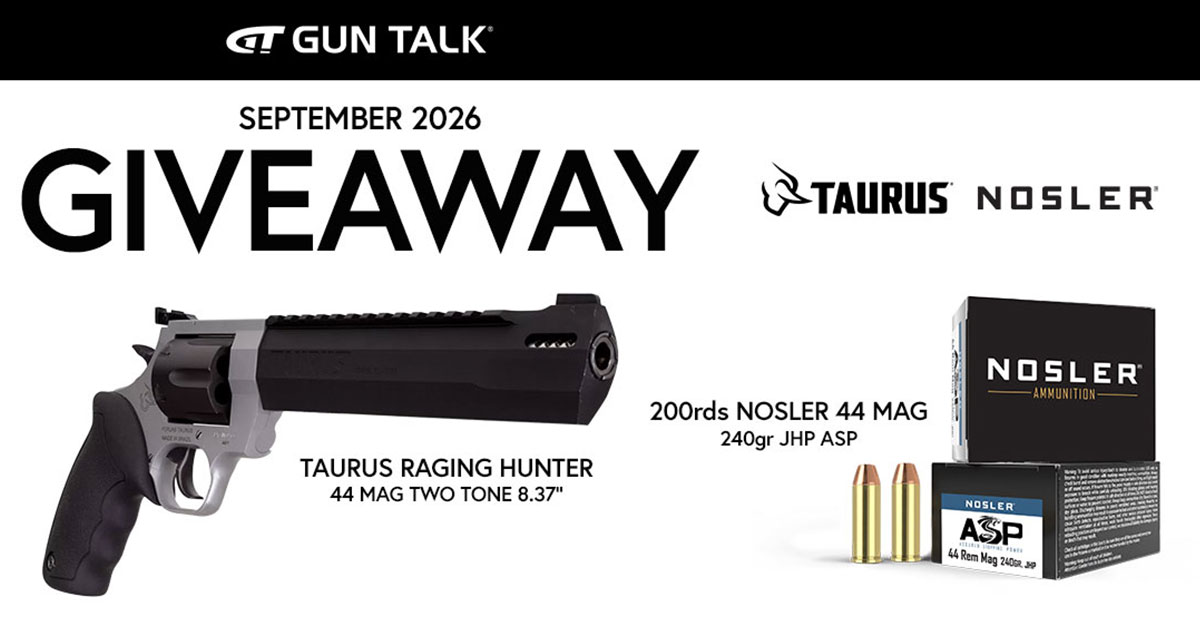
Gun Talk Giveaway
One lucky winner will bring home:
Open to U.S. residents 21+ only. Void where prohibited.