August 21, 2026
Gun Talk Staff
Every serious cartridge has a creation myth. The 10mm Auto's is better than most. In 1983, Jeff Cooper — the father of the Modern Technique of pistol shooting, founder of Gunsite Academy, the man who codified the four rules of gun safety, the most influential American firearms instructor of the 20th century — conceived a pistol cartridge that could do what no semi-automatic round had done before: deliver magnum-level terminal performance in a magazine-fed platform. Norma developed the cartridge. Dornaus & Dixon built it into the Bren Ten. It was supposed to be the cartridge that finally made the .45 ACP obsolete.
Then the FBI happened.
After the 1986 Miami Shootout, in which two agents were killed and five wounded — partly because their .38 Special and 9mm rounds failed to stop suspects quickly enough — the FBI went looking for a more powerful duty cartridge. They adopted the 10mm in 1989, chambered in a Smith & Wesson 1076. The problem: full-power 10mm is a genuinely demanding cartridge. Agents with smaller hands struggled to qualify with the full-power load, and the Bureau downloaded the round to a reduced-velocity spec that agents could actually manage. Smith & Wesson then worked with Winchester to develop the .40 S&W, which duplicated the FBI's downloaded 10mm ballistics in a shorter case that fit 9mm-size frames. By the mid-1990s, the FBI was shooting .40 S&W and 10mm was an orphan cartridge.
Except it wasn't. Glock introduced the G20 in 1991 and the G29 in 1997, giving the cartridge a reliable, affordable platform that hunters and outdoorsmen could actually buy. The people who found full-power 10mm too demanding for qualification — FBI agents who needed to qualify under stress without extensive training — turned out to be a different population than backcountry hikers, handgun hunters, and people who genuinely want the most powerful mainstream semi-automatic cartridge available. That population kept 10mm alive through the lean years. And now 10mm is in its resurgence.
“What was too much gun for the average agent turned out to be just right for hikers, hunters, and those who spend serious time off the grid. The same characteristics that once made 10mm a liability in law enforcement — power, penetration, and velocity — made it ideal for bear defense, backcountry carry, and handgun hunting.” — G9 Defense, 2026
The 10mm Auto debate is complicated by the fact that not all 10mm is the same. Half the loads sold as “10mm” today are not full-power 10mm. The original Norma 10mm specification pushes a 180-grain bullet to roughly 1,300 fps. The FBI's downloaded spec ran 180 grains at approximately 950–1,030 fps — a load that was later renamed and reformatted into .40 S&W. When you buy a box of 10mm ammunition, check the velocity number on the box before you assume you're getting the cartridge Jeff Cooper envisioned.
Full-power 10mm runs at 37,500 psi — comparable chamber pressure to 9mm but with a heavier, faster bullet. The practical energy output: 180-grain loads at 1,200+ fps generate approximately 575–640 ft-lbs at the muzzle. 200-grain defensive loads at 1,100–1,130 fps generate 535–567 ft-lbs. 220-grain hard-cast hunting loads at 1,200 fps generate approximately 703 ft-lbs. For comparison, a .357 Magnum from a 4-inch barrel generates approximately 530–560 ft-lbs. Full-power 10mm exceeds .357 Magnum energy and approaches .41 Magnum territory — from a magazine-fed semi-automatic.
| Federal HST 200gr (defense) | 1,130 fps │ 567 ft-lbs │ Best defensive load │ Reliable expansion, 12–16" penetration │ Meets FBI protocol |
|---|---|
| Sig V-Crown 180gr (defense) | 1,150 fps │ ~529 ft-lbs │ Clean hollow point expansion │ Good mid-range option |
| Hornady Critical Duty 175gr (defense) | 1,190 fps │ ~551 ft-lbs │ FlexLock barrier-blind │ Best for full-size pistols in urban carry |
| Hornady XTP 180gr (hunting) | 1,275 fps │ ~650 ft-lbs │ Excellent deer/hog load │ Controlled expansion through bone |
| Buffalo Bore 220gr Outdoorsman (bear) | 1,200 fps │ 703 ft-lbs │ Hard cast │ Deep penetration │ The bear country standard |
| Underwood 220gr Hard Cast (bear) | 1,200 fps │ ~703 ft-lbs │ Direct competitor to Buffalo Bore │ Flat nose for maximum penetration |
| CCI Blazer Brass 180gr (range) | 1,200 fps │ ~575 ft-lbs │ Full-power training load │ Most affordable full-spec 10mm option |
| FBI-lite spec (AVOID for hunting/bear) | 950–1,030 fps │ ~360–424 ft-lbs │ Performs like .40 S&W │ Fine for target shooting, wrong load for bear defense |
Let's be direct about something before the list: the 10mm revolver category is small. Only a few manufacturers currently produce 10mm revolvers, and one of the ones we're featuring here offers two configurations. If you came here expecting twelve options, this guide will disappoint you. If you came here wanting to understand exactly what's available and why it matters, the models below will reward you.
The reason 10mm revolvers are rare is the same reason any unusual-caliber revolver is rare: moon clip dependency. The 10mm Auto is a rimless cartridge designed for semi-automatic magazines. Revolvers need a rim or a mechanism to extract spent cases. Moon clips — thin metal discs that hold multiple cartridges and provide the rim for extraction — are the solution. They work well once you're practiced with them. They add a step to the manual of arms that requires deliberate learning. And they limit the appeal to shooters willing to invest in that learning curve.
The Rhino 60DS is the only production revolver with a bottom-cylinder barrel — the bore axis sits at the 6-o'clock position rather than 12, putting it in line with the shooter's wrist rather than above it. The practical consequence in 10mm is transformative: felt recoil travels straight back into the wrist rather than torquing the muzzle upward, making a 10mm revolver feel significantly softer than a conventional wheelgun of the same weight shooting the same ammunition. Multiple reviewers have compared the Rhino 60DS's 10mm recoil profile to a conventional .357 Magnum revolver. The 6-inch barrel, integrated Picatinny frame rail, fiber optic front sight, and adjustable rear make this a serious field gun. Ships with three moon clips. NRA American Rifleman went in skeptical and came out a convert. GunsAmerica called it “The Weird Recoil Killer.” Both assessments are accurate, and the physics backs them up.
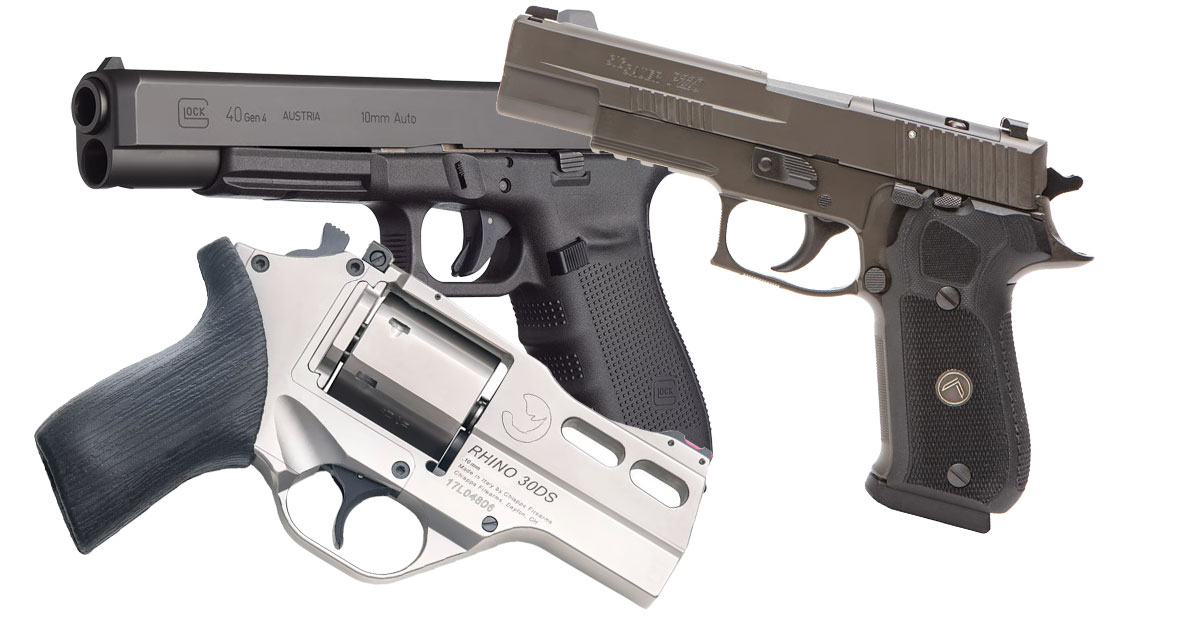
The 30DS is the compact sibling of the 60DS: same bottom-cylinder bore axis, same moon clip system, same Italian construction — in a 3-inch barrel configuration with a nickel finish. Where the 60DS is a field gun, the 30DS makes the case for a 10mm revolver as a serious defensive or backcountry carry option. Three inches of 10mm barrel still generates meaningful energy — you're giving up velocity relative to the 6-inch but retaining the caliber's fundamental advantage over .357 Magnum in penetration and energy. The low-bore-axis design is arguably more valuable on a compact revolver than a full-size one, because managing recoil on a shorter, lighter gun is more challenging. The Rhino's geometry turns that physics problem into an advantage. For a hiker who wants 10mm in a packable revolver, or a hunter who wants a field backup that doesn't weigh as much as the 60DS, the 30DS is the answer this category offers.
The GP100 is one of the most respected double-action revolver platforms in American firearms history. It is famously overbuilt — heavier and stronger than its caliber technically requires — which makes it ideal for hot 10mm loads that would stress a lighter-framed revolver over time. The Match Champion variant adds a fiber optic Novak front sight, a semi-target hammer, match-grade barrel crown, and a smoothed action that makes the double-action pull noticeably better than standard GP100 production. The 10mm GP100 runs a 6-shot cylinder, ships with moon clips, and handles any 10mm load you can source including full-house Buffalo Bore and Underwood hunting loads. The GP100's triple-locking cylinder and the strength of its frame are genuinely appropriate for a cartridge that runs at 37,500 psi. The honest caveat: the 10mm GP100 is listed as limited availability by Ruger. You will need to search, and you should expect to pay above MSRP if you find one. It is worth the effort.
Because the 10mm revolver category is genuinely limited, a complete 10mm guide has to address the semi-automatic options honestly — both because they represent the bulk of the market and because understanding them helps you decide whether a revolver actually serves your purpose or whether you're reaching for a wheelgun when a semi-auto would serve you better.
The Glock 20 is the reason 10mm survived the 1990s. When the FBI walked away and the S&W 1076 disappeared, Glock kept building the G20 and selling it to hunters, outdoorspeople, and handgun hunters who knew what the cartridge could do. The Gen 5 MOS version adds the optics cut that the platform always needed. 15+1 capacity, the deepest 10mm aftermarket of any platform on earth, and the same Glock reliability that has made the brand the most trusted duty pistol worldwide. Street price approximately $621. For anyone who wants 10mm and doesn't have a strong reason to choose a revolver, this is the recommendation.
The G40 is the long-slide 10mm Glock, with a 6.02-inch barrel that extracts every available foot-per-second from the cartridge. Factory MOS optic cut, same 15+1 capacity as the G20, and the velocity numbers that make 10mm worth talking about in the first place. The additional barrel length makes it the choice for handgun hunters who want maximum performance at field distances. Street price approximately $700.
For shooters who want single-action accuracy and 10mm power in the same package, the Dan Wesson Kodiak is the answer the 1911 platform provides in the 10mm chambering. Hand-fit components, adjustable rear sight, compensated barrel, 8+1 capacity. Not a carry gun due to weight and size. The right choice for a shooter who wants maximum precision from 10mm in a range or hunting context. Street price approximately $2,099.
The P220 Legion in 10mm is the all-steel, hammer-fired alternative for shooters who want a safety or a decocking mechanism on their 10mm platform. DA/SA trigger, Legion-grade trigger work, SIG build quality. 8+1 capacity from a single-stack steel frame. Not a capacity leader, but a precision and ergonomics leader for the right shooter profile.
| You want revolver + 10mm | Chiappa Rhino 60DS for field/range │ Rhino 30DS for compact carry │ Ruger GP100 Match Champion if you can find one. Revolver offers simplicity, no magazine dependency, and mechanical reliability with any load. Moon clips required. |
|---|---|
| You want max capacity + 10mm | Glock 20 Gen5 MOS (15+1) or Glock 40 MOS (15+1 with longer barrel). No other 10mm platform approaches this capacity from a factory configuration. |
| Bear / large predator defense | Glock 20 for capacity + reliability with hard-cast loads │ GP100 for revolver reliability │ Rhino 60DS for revolver + low-recoil follow-ups. Load with Buffalo Bore or Underwood 220gr hard cast regardless of platform. |
| Handgun hunting | Glock 40 MOS (6" barrel, maximum velocity, optics-ready) │ Dan Wesson Kodiak (1911 precision) │ Rhino 60DS (6" + rail for optics). Use Hornady XTP 180gr or Federal Fusion bonded loads. |
| Home defense | Glock 20 or 29 with Federal HST 200gr. Revolver if you prioritize manual-of-arms simplicity. DO NOT load hard-cast hunting rounds for home defense. |
| Concealed carry | Glock 29 (subcompact, 10+1) or Rhino 30DS (3" compact revolver). Both are serious compromises vs. 9mm platforms in shootability and capacity. Consider whether 10mm is actually right for your carry profile. |
| Budget | Glock 20 Gen5 MOS (~$621 street) is the entry point. The Ruger GP100 Match Champion (~$999) is the revolver entry point when available. The Rhino and 1911 options all run $1,100+. |
Both the Chiappa Rhino and the Ruger GP100 10mm use moon clips, and this is worth more explanation than it usually gets in revolver reviews. The 10mm Auto is a rimless cartridge — it does not have the protruding rim that revolver extractors use to eject spent cases. Moon clips are thin metal discs that hold six cartridges in a circular arrangement and provide the rim. When you load a 10mm revolver, you load an entire moon clip at once. When you fire and need to reload, you eject the moon clip (with spent cases attached), seat a fresh loaded moon clip, and you're back in the fight.
The advantages: faster reloading than speed loaders for rimmed cartridges, uses standard rimless pistol ammunition rather than a proprietary revolver-specific load, and the moon clip assembly keeps cartridges organized for carry.
The disadvantages: moon clips require a specific manual of arms that takes practice to run under stress. A bent or damaged moon clip can prevent loading. You need a de-mooning tool to remove spent cases from used clips. And loading individual rounds into a 10mm revolver without a moon clip is not practical in the field.
The 10mm Auto in 2026 occupies a specific niche that it earned honestly: the most powerful mainstream semi-automatic pistol cartridge in production, delivering near-.41 Magnum energy from a magazine-fed platform. For hunters, backcountry travelers, and anyone operating in terrain where large predators are a realistic threat, it is the right answer to the question “what handgun caliber?” in a way that no standard defensive cartridge is.
The revolvers featured in this guide are few by design. Three configurations, all using moon clips, all requiring deliberate investment in a new manual of arms. The Chiappa Rhino 60DS is the most technically interesting of the three — its low-bore-axis design solves the 10mm revolver's biggest challenge and does it in a way no other revolver on the market does. The Ruger GP100 Match Champion is the proven American alternative when you can find one. The Rhino 30DS is the compact carry version for those who want 10mm in a packable revolver.
If your use case is 10mm and you're not attached to the revolver format, the Glock 20 Gen5 MOS remains the recommendation — 15+1 of the most powerful mainstream semi-auto cartridge available, the deepest aftermarket on earth, and the platform that single-handedly kept the cartridge alive when the FBI walked away from it. The cartridge is good. The platforms are numerous. The choice is yours.
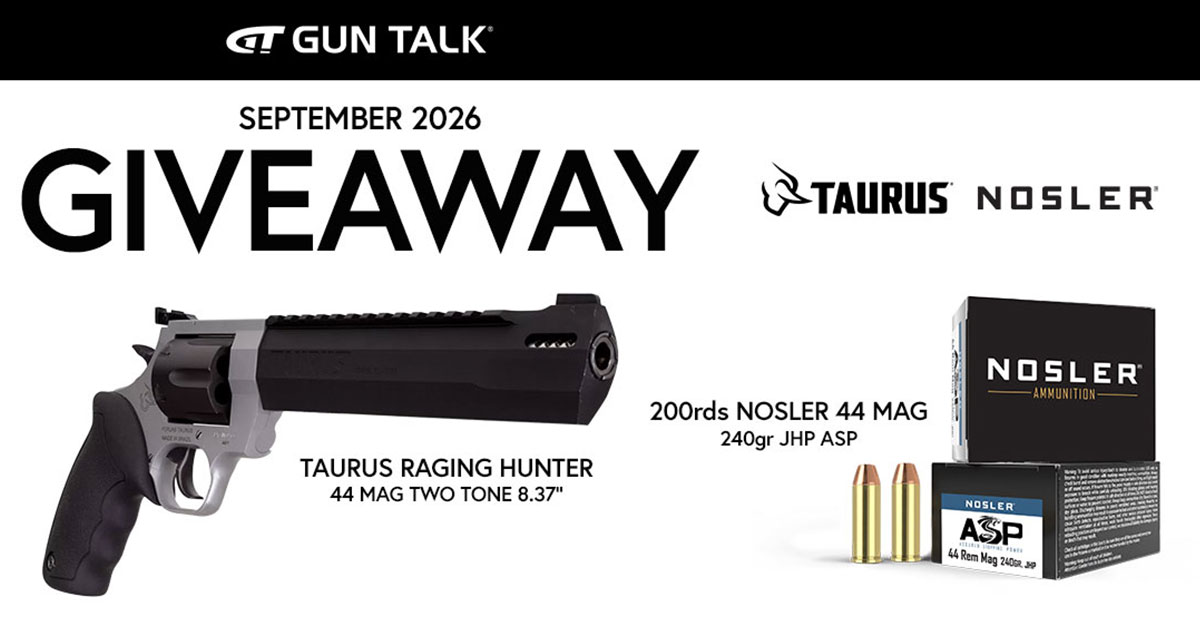
Gun Talk Giveaway
One lucky winner will bring home:
Open to U.S. residents 21+ only. Void where prohibited.