August 3, 2026
For most of its life, the 5.7x28mm was a curiosity. A NATO cartridge with a weird bottleneck case, chambered in two expensive guns most Americans would never own, wrapped in enough political controversy that half the people who had opinions about it had never fired one.
That's over. There are now more than a dozen firearms chambered in 5.7 from Ruger, Smith & Wesson, PSA, Kel-Tec, FN, Tisas, and CMMG. Ammunition that used to run north of a dollar a round now sits closer to 35-45 cents. Subsonic loads exist. Threaded barrels are standard. The cartridge finally has the ecosystem it needed thirty years ago.
Whether it deserves a spot in your safe is a different question — and one this guide will answer honestly. Here's everything you need to know.
In 1989, NATO issued a document called D/296, calling for a replacement for the 9x19mm in personal defense weapons and sidearms. The requirement was specific: the new round needed to defeat body armor at combat distances, weigh less than 9mm so soldiers could carry more of it, and produce less recoil so support troops — drivers, mechanics, radio operators — could put rounds on target without extensive training.
FN Herstal answered with the 5.7x28mm. Belgian engineers essentially took the concept of a rifle cartridge and shrank it — a bottlenecked case pushing a .224-caliber bullet at velocities no handgun round had ever seen. It wasn't a scaled-down 5.56; it was designed from scratch, with its own case dimensions, its own pressure curve, and its own bullet profile.
The gun came first. In 1990, FN introduced the P90 — a bullpup personal defense weapon with a 50-round magazine that fed rounds horizontally over the bore and rotated them 90 degrees on the way into the chamber. It looked like nothing else on earth, and it worked. The Five-seveN pistol followed in 1998, giving operators a sidearm that shared ammunition with the PDW.
Heckler & Koch entered the same competition with the 4.6x30mm and the MP7. NATO ran comparative trials in 2002 and 2003. The results were contested enough that no standardization decision was ever finalized, and both cartridges went on to be adopted piecemeal by various countries and agencies. The 5.7 has been fielded by more than 40 nations.
In the United States, the Secret Service, various federal agencies, and a number of law enforcement departments have used P90s and Five-seveNs over the years. But for civilian shooters, the cartridge stayed expensive and obscure until Ruger changed the math in 2019.
The 5.7x28mm does something no other handgun cartridge does: it pushes a very light, very fast, very aerodynamic bullet.
A standard 40-grain 5.7 load leaves a pistol barrel at roughly 1,750 fps. From a 16-inch carbine, that same round can approach 2,100-2,200 fps. Compare that to a 9mm 124-grain load at 1,150 fps and you start to see why the cartridge behaves so differently downrange.
Muzzle energy is roughly 270-300 ft-lbs from a pistol — a bit less than a hot 9mm load. That number alone makes the 5.7 look unimpressive, and it's the stat critics lead with. But energy is only part of the picture.
Trajectory is where the 5.7 separates itself. That spitzer bullet holds velocity far better than a blunt handgun projectile. At 100 yards, a 5.7 is still traveling faster than a 9mm is at the muzzle. Practical hits at 50, 75, even 100 yards with a pistol are realistic in a way they simply aren't with most defensive handgun cartridges.
Recoil is nearly nonexistent. A 40-grain bullet at 1,750 fps generates less felt recoil than a .22 WMR out of a comparable gun. Follow-up shots are fast, muzzle rise is minimal, and shooters who flinch with 9mm often shoot the 5.7 noticeably better.
Capacity is the other headline. The FN Five-seveN and most of its competitors hold 20 rounds standard. The FN PS90 holds 50. The tiny case diameter means you fit more rounds in the same space.
Weight matters if you're carrying a lot of ammunition. A loaded 20-round 5.7 magazine weighs meaningfully less than a loaded 17-round 9mm magazine.
5.7x28 vs. 9mm Luger: The 9mm delivers more energy, has vastly better ammunition selection, costs half as much per round, and is available at every gun counter in America. The 5.7 offers less recoil, flatter trajectory, higher capacity, and better performance past 50 yards. For a defensive handgun at typical engagement distances, the 9mm remains the more practical choice for most people. For a home defense carbine, a range gun, or a shooter who is genuinely recoil-sensitive, the 5.7 makes a real case for itself.
5.7x28 vs. .22 WMR: This is the comparison the 5.7's critics love, and it's not entirely unfair on paper — similar bullet diameter, similar bullet weights, roughly comparable velocities from short barrels. But the 5.7 is a centerfire cartridge with modern bullet construction, dramatically better reliability than any rimfire, and defensive loads engineered to expand. The .22 WMR was designed in 1959 to shoot small game. They're not the same tool.
5.7x28 vs. .223/5.56 NATO: They share bullet diameter and nothing else. The 5.56 has roughly four times the case capacity and produces 1,200+ ft-lbs from a carbine. The 5.7 is a handgun cartridge that happens to work well in short carbines. If you want rifle performance, buy a rifle — check out our Best AR-15 for Beginners guide.
5.7x28 vs. 4.6x30mm HK: The 5.7's direct competitor from the NATO trials. The 4.6 uses an even lighter bullet at slightly higher velocity. Neither cartridge won the standardization fight. The 4.6 remains almost entirely unavailable to American civilians, while the 5.7 has thrived commercially.
You cannot write about the 5.7 without addressing this, so let's be clear about the facts.
The original military load — designated SS190 — used a steel-and-aluminum core projectile designed to defeat soft body armor. That round is restricted to military and law enforcement sales in the United States. It is not sold to civilians, and it has never been sold to civilians.
Every commercially available 5.7x28mm load — SS195LF, SS197SR, and the offerings from Federal, Fiocchi, Speer, Hornady, and PSA's AAC line — uses conventional lead-core or lead-free projectiles. These are not armor-piercing rounds. The ATF has evaluated commercial 5.7 ammunition and has not classified it as armor-piercing under 18 U.S.C. § 921(a)(17)(B).
The confusion has been politically useful to some people over the years, and it generated a wave of "cop killer bullet" headlines in the mid-2000s that the cartridge is still shaking off. What's actually true: any centerfire rifle cartridge, including the .30-30 your grandfather hunted with, will defeat soft body armor. That's why armor is rated by threat level. The 5.7 in its commercial loadings is not a special case.
The pistol market has exploded. Here's what's actually available.

Capacity: 20+1
Barrel: 4.8", threaded
Weight: 25 oz.
MSRP: Approximately $1,499
The original, and still the benchmark. FN designed the gun and the cartridge together, and it shows. The delayed blowback action combined with the 5.7's inherent softness makes this one of the flattest-shooting pistols on the market — rapid strings at 25 yards stay tight in a way that surprises people the first time they run one.
The MK3 MRD finally added the factory optics cut the platform needed. The polymer frame keeps weight down, the ambidextrous controls work well, and the reliability record over 25+ years is excellent.
The knocks: it's the most expensive option on this list by a wide margin, and the trigger is a love-it-or-hate-it proposition. It's a long, somewhat spongy pull that some shooters never warm to.
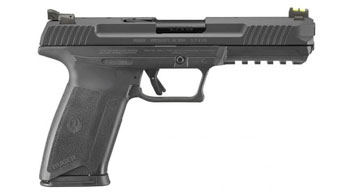
Capacity: 20+1
Barrel: 4.94", threaded
Weight: 24.5 oz.
MSRP: Approximately $799
The gun that made the 5.7 mainstream. Ruger took the concept, built it around a conventional secure-action design with a much better trigger than the FN, added a factory optics cut, and undercut the Five-seveN by hundreds of dollars.
Ruger's version uses a patented internal hammer with a bladed safety, giving it a crisp break and short reset that feels far more like a modern striker gun than the FN's trigger does. Fit and finish are what you'd expect from Ruger — functional rather than beautiful — but the gun works, the aftermarket has caught up, and the price is right.
If you want one 5.7 pistol and value is a consideration, this is the default recommendation.

Capacity: 22+1
Barrel: 5", threaded
Weight: 27.5 oz.
MSRP: Approximately $699
S&W's entry brings the highest standard capacity in the category and the familiar M&P grip that a huge number of shooters already know. It uses a gas-operated locking system S&W calls the Tempo barrel system, which is genuinely novel in a handgun and contributes to how soft it shoots.
Optics-ready from the factory, threaded barrel standard, and the M&P ergonomics carry over well. For anyone already running M&P pistols, this is the path of least resistance into the cartridge.
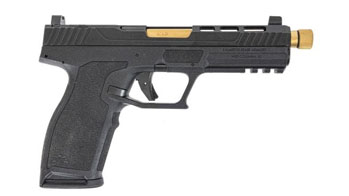
Capacity: 23+1
Barrel: 5.2", threaded
Weight: 26 oz.
MSRP: Approximately $549
Palmetto State Armory's entry has done for 5.7 pistols what PSA has done for AR-15s — driven the price floor down and forced everyone else to compete. The Rock uses a rotating barrel design, comes optics-ready with a threaded barrel, and holds 23 rounds.
The build quality won't match the FN, and the aftermarket is thinner than Ruger's or S&W's. But at street prices frequently under $500, the Rock is the cheapest legitimate way to find out whether you like the cartridge. PSA also produces 5.7 ammunition under its AAC brand, which has helped the entire ammo situation.

Capacity: 20+1
Barrel: 5.2", threaded
Weight: 27 oz.
MSRP: Approximately $499
The only DA/SA hammer-fired option in the category — genuinely unique, and worth noting for shooters who prefer a long first-pull for carry. It also accepts FN Five-seveN magazines, which means you're not locked into proprietary mags.
The tradeoffs are weight (it's the heaviest here) and an essentially nonexistent aftermarket. Holsters and accessories are hard to come by. But Tisas has built a real reputation for value in the American market, and the PX-5.7 continues that. For our take on Tisas quality generally, see our Tisas PX-9 review.
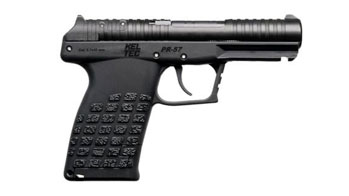
Capacity: 20+1
Barrel: 3.9"
Weight: 15.6 oz.
MSRP: Approximately $399
Leave it to Kel-Tec to build the weirdest gun in the category. The PR57 has no detachable magazine — it feeds from an internal 20-round column loaded via stripper clips through the top of the gun. It's the lightest and thinnest 5.7 pistol made, which makes it the only realistic concealed carry option in the caliber.
Whether the stripper-clip reload is charming or disqualifying depends entirely on your temperament. It's slow. But for a gun you carry and hopefully never fire, 20 rounds of 5.7 in a 15.6-ounce package that's under an inch wide is a legitimately interesting proposition.

Capacity: 50+1
Barrel: 9.6"
Weight: 64 oz.
MSRP: Approximately $1,099
A large-format pistol that accepts P90 magazines — all 50 rounds of them. The original P50 required opening the gun like a clamshell to reload; the newer KP50 fixed that with a bottom-loading design and added a folding brace. It's absurd, impractical, and enormously fun. We covered a brace upgrade for the platform in our FarrowTech folding brace video.
MasterPiece Arms Defender 5.7 — A MAC-pattern large-format pistol taking Five-seveN magazines. Short 5" barrel doesn't extract much velocity from the cartridge, but the platform is inexpensive and SBR-friendly.
Diamondback DBX57 — An AR-style large-format pistol with an 8" barrel that does considerably better justice to the round's ballistic potential. Takes Five-seveN magazines.
CMMG Banshee MK57 — CMMG's radial delayed blowback system in 5.7, available in pistol and SBR configurations, running FN magazines. Premium pricing, premium build.
The 5.7 arguably makes more sense from a carbine barrel than a pistol barrel. Longer barrels give the cartridge room to build velocity, pushing 40-grain loads past 2,100 fps and turning a middling handgun round into something genuinely capable inside 150 yards.

Capacity: 50+1
Barrel: 16"
Weight: 6.4 lbs.
MSRP: Approximately $1,749
The civilian-legal P90. A bullpup with a top-mounted 50-round magazine that feeds horizontally, a downward-ejecting design that works equally well for left- and right-handed shooters, and a manual of arms unlike anything else you'll pick up.
Twenty-plus years in, the PS90 is still one of the most distinctive firearms available. It's compact for a 16-inch-barreled rifle thanks to the bullpup layout, the recoil is essentially nil, and 50 rounds on tap is 50 rounds on tap. The trigger is mediocre, optics mounting is awkward, and the price is high — but nothing else feels like it.
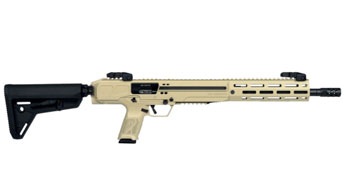
Capacity: 20+1
Barrel: 16.25", threaded
Weight: 5.9 lbs.
MSRP: Approximately $999
Ruger did to the PS90 what the Ruger-5.7 did to the Five-seveN: made it conventional, made it cheaper, and made it work with familiar controls. The LC Carbine uses the same fire control unit and the same magazines as the Ruger-5.7 pistol, which is a significant convenience if you own both.
It has a side-folding, adjustable stock, a full-length top rail for easy optics mounting, a threaded barrel from the factory, and it folds to under 23 inches. At roughly half the PS90's price with better ergonomics and simpler optics mounting, it's the most practical 5.7 carbine on the market.
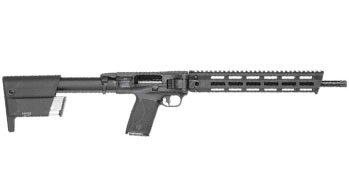
Capacity: 22+1
Barrel: 16.25", threaded
Weight: Approximately 5.5 lbs.
S&W brought the folding carbine concept to 5.7, and the appeal is obvious — a carbine that folds in half and shares magazines with the M&P 5.7 pistol. The FPC platform has been well received in 9mm and the 5.7 version extends the concept into a flatter-shooting, lighter-recoiling package.

CMMG's radial delayed blowback action in an AR-pattern package, running FN Five-seveN magazines. Available in pistol, SBR, and rifle configurations. The AR manual of arms, full rail real estate, and CMMG's build quality make this the premium option for shooters who want 5.7 on a familiar platform. Expect to pay for it.
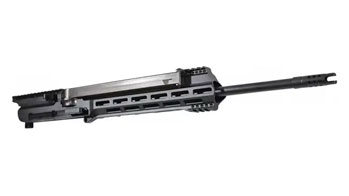
A conversion upper that mounts to any standard AR-15 lower and feeds from P90 magazines mounted on top of the receiver, ejecting spent cases down through the magwell. If you already own AR lowers, this is the cheapest entry into a 5.7 carbine — and one of the more clever designs in the category.
The 5.7 is an excellent suppressor host, but there are things you need to understand before you buy a can.
Thread pitch: Most 5.7 firearms use 1/2x28 threading, the same as .22 LR and 5.56. Some FN products use 28x0.5mm metric threading, which is close but not identical — check your specific gun before ordering a mount or a direct-thread can. Adapters are available.
Bore diameter: The 5.7 uses a .224-caliber projectile, so any suppressor rated for 5.56/.223 will accommodate it dimensionally. Many shooters also run 9mm cans, which have plenty of bore clearance and often provide better sound reduction on pistol-velocity loads due to the larger internal volume.
The supersonic problem: Standard 5.7 ammunition travels at 1,750-2,200 fps — well past the sound barrier. A suppressor will reduce the muzzle blast substantially, but the ballistic crack of the bullet breaking the sound barrier is unaffected by anything happening at the muzzle. You'll get a meaningful reduction, not a Hollywood whisper.
Subsonic ammunition: This is where it gets interesting. Fiocchi's 62-grain Range Dynamics subsonic load runs at approximately 1,050 fps — under the sound barrier, and heavy enough to generate the back pressure needed to cycle semi-auto actions. Paired with a suppressor, it turns a 5.7 into something remarkably quiet. Testing has shown it produces more terminal damage than .22 LR or .22 WMR at comparable velocities, which makes sense given the heavier bullet and centerfire construction. Verify cycling in your specific gun before relying on it.
Suppressor recommendations: A quality 5.56-rated can will handle 5.7 without issue — the Banish 30, SilencerCo Omega, and Dead Air Sandman family all work. For pistol use, 9mm cans like the Rugged Obsidian 9 or SilencerCo Osprey are popular choices, though you'll want to confirm the mount and booster setup work with your host. Note that direct-thread cans on a delayed blowback pistol may affect cycling — some shooters run a fixed barrel spacer instead of a booster.
Blowback: Suppressing any semi-auto increases gas blowback to the shooter's face. It's noticeable on 5.7 pistols. An adjustable gas system isn't an option on most of these guns, so expect some gas in your face and shoot with eye protection.
With the federal suppressor tax stamp eliminated as of January 2026, the barrier to entry has never been lower. For more on the current suppressor market, read our Lyman Sonicore Suppressors review and our SureFire Fast Attach Hub breakdown.
Ammunition selection has improved dramatically in the last five years. Here's what to load.
For self-defense: Speer Gold Dot 40-grain is the most established defensive load in the caliber, using a bonded hollow point engineered to expand at 5.7 velocities. Federal Punch 40-grain is another purpose-built defensive option. FN's SS197SR — the blue-tip Sporting Round — uses a Hornady V-MAX projectile and remains one of the most accurate and consistent loads available.
For range and training: Federal American Eagle 40-grain FMJ, Fiocchi Range Dynamics 40-grain, and PSA's AAC 40-grain are the volume options. Expect roughly $0.35-0.50 per round, which is a dramatic improvement over where this cartridge was five years ago but still runs about double the cost of 9mm range ammo.
For suppressed shooting: Fiocchi 62-grain subsonic is currently the only widely available subsonic option from a major manufacturer.
For varmints and small game: Any of the 40-grain V-MAX or polymer-tipped loads perform well on coyote-sized game inside 100 yards from a carbine. The flat trajectory is a real advantage in the field.
A note on reloading: Don't count on it. FN applies a polymer coating to factory 5.7 cases that complicates resizing and case prep considerably. Dies exist and people do reload the cartridge successfully, but it's fussy work compared to reloading a straight-walled pistol case or a conventional rifle cartridge. If your interest in a caliber depends on handloading, the 5.7 will frustrate you.
Home defense carbine: This is arguably the cartridge's best civilian application. A 5.7 carbine gives you 20-50 rounds, minimal recoil, manageable muzzle blast in an enclosed space (especially suppressed), and enough terminal performance for the job. Lightweight, fast-moving projectiles also tend to shed energy quickly after hitting drywall, which is a legitimate consideration in a home. If you're weighing options, compare against our Best Home Defense Shotguns guide.
Recoil-sensitive shooters: For someone with arthritis, a shoulder injury, limited hand strength, or an established flinch, the 5.7 offers a defensive option with real capacity and near-zero recoil. That's a genuine use case that doesn't get enough attention.
Varmint and predator control: From a carbine, the 5.7 is a legitimate coyote and hog-adjacent cartridge inside 100-125 yards. Quiet with subsonics, flat-shooting with standard loads, and cheap enough to practice with.
Range fun: Let's be honest — a lot of people buy 5.7 guns because they're a blast to shoot. Fast, flat, loud, and you can put 20 rounds into a small group faster than you'd think. That's a valid reason to own a gun.
Concealed carry: This is where the 5.7 struggles. Most 5.7 pistols are full-size guns with 5-inch barrels — big for daily carry. The Kel-Tec PR57 is the exception, and the 20-round capacity in a slim, lightweight package is compelling. But for most people, a compact 9mm remains the better carry choice. See our Best 9mm Pistols for Concealed Carry for those options.
A definitive guide has to include the parts the fans skip.
Ammunition cost. It's come down enormously, but 5.7 still runs roughly double 9mm for comparable range ammo. If you shoot a lot, that adds up.
Ammunition availability. Every gun shop in America stocks 9mm. Not every gun shop stocks 5.7. In a supply crunch, the niche cartridge is the one that disappears from shelves first and comes back last.
Terminal performance is debated. The 5.7's defenders point to velocity, fragmentation, and hit probability. Its critics point to modest energy figures and a bullet that weighs less than a third of a 9mm projectile. The honest answer is that modern defensive 5.7 loads meet FBI penetration standards and expand reliably, but the cartridge does not have the decades of documented street performance that 9mm, .45, and .357 have. Reasonable people disagree.
Reloading is difficult. Covered above, but worth repeating for anyone who handloads everything.
It doesn't do anything better than an alternative. For pure defensive handgun duty, 9mm is better supported and cheaper. For a carbine, 5.56 hits harder. For a suppressed subsonic gun, .300 Blackout is purpose-built for it. The 5.7's argument isn't that it's best at one thing — it's that it's unusually good at a specific combination of things: capacity, recoil, weight, and flat trajectory, all in one package.
Is 5.7x28mm good for self-defense?
Yes, with the right load. Purpose-built defensive rounds like Speer Gold Dot and Federal Punch meet FBI penetration protocols and expand reliably at 5.7 velocities. The cartridge offers high capacity, negligible recoil, and excellent hit probability under stress. That said, 9mm has more documented real-world performance data, cheaper ammunition, and universal availability. Both are legitimate choices; 9mm is the more conservative one.
Is 5.7 ammo armor piercing?
No. The armor-piercing SS190 military load is restricted to law enforcement and military and has never been sold to civilians. Every commercially available 5.7x28mm load uses conventional lead-core or lead-free projectiles and is not classified as armor-piercing ammunition under federal law.
How much does 5.7x28mm ammo cost?
Range ammunition runs approximately $0.35-0.50 per round in 2026, down substantially from the $1+ per round prices of a few years ago. Defensive loads run $1.00-1.50 per round. PSA's AAC brand and increased production from Fiocchi and Federal have driven prices down considerably.
What's the best 5.7 pistol?
Depends on the priority. For overall value and a better trigger, the Ruger-5.7. For maximum capacity and familiar M&P ergonomics, the Smith & Wesson M&P 5.7. For the lowest price of entry, the PSA Rock 5.7. For the original and best-refined execution of the platform, the FN Five-seveN MK3 MRD. For actual concealed carry, the Kel-Tec PR57.
Can you suppress a 5.7?
Yes. Most 5.7 firearms have 1/2x28 threaded barrels from the factory, and any 5.56- or 9mm-rated suppressor will work dimensionally. Standard supersonic ammunition still produces a ballistic crack, so pair it with Fiocchi's 62-grain subsonic load for the quietest results. With the federal tax stamp eliminated in January 2026, suppressor ownership costs less than it ever has.
Is 5.7x28mm just a fancy .22 Magnum?
No, though the comparison gets made constantly. Similar bullet diameter and weight, but the 5.7 is a centerfire cartridge with modern bonded and expanding bullet designs, dramatically better ignition reliability than any rimfire, higher velocity from carbine-length barrels, and defensive loads engineered specifically for terminal performance. The .22 WMR is a small game cartridge from 1959.
What's the effective range of the 5.7x28mm?
From a pistol, practical hits on man-sized targets are realistic to 100 yards — well past what most handgun cartridges can manage. From a 16-inch carbine, 150-200 yards is achievable with an optic. The flat trajectory is the cartridge's defining ballistic advantage.
Does the 5.7 have significant recoil?
Almost none. A 40-grain bullet at 1,750 fps produces less felt recoil than most .22 WMR handguns. This makes the 5.7 one of the best options available for recoil-sensitive shooters who still want meaningful capacity and defensive capability.

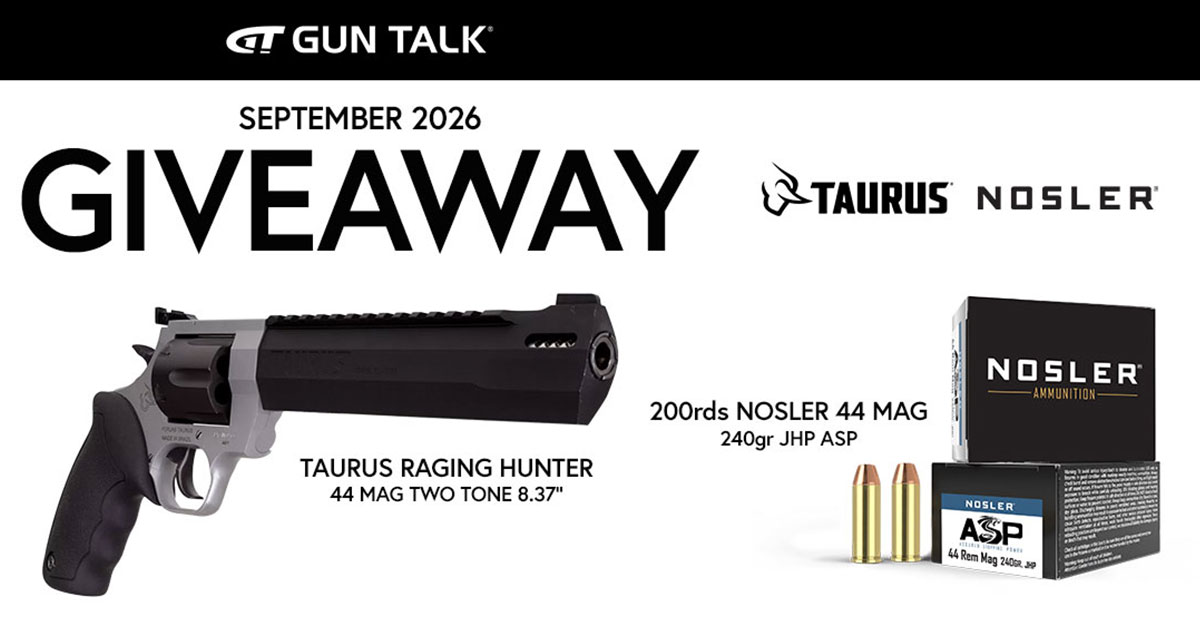
Gun Talk Giveaway
One lucky winner will bring home:
Open to U.S. residents 21+ only. Void where prohibited.